


Whistleblowers are supposed to hide. Anonymous tips, sealed filings, a lawyer who does the talking — that’s the bargain, because the institutions being reported are usually strong enough to end the person reporting them. That bargain rests on one assumption: that the regulator or law enforcement agency receiving the tip will act on it.
Mine went in six years ago — sworn, through the SEC’s front door, filed by the principal architect of the SEC’s own whistleblower program, Sean McKessy of Phillips and Cohen, LLP. Sean submitted the tip to the government system that he built and then led as its first Chief. Receipt in hand. What followed was six years of silence — half a trillion dollars of investor losses — and an industry that learned to read the SEC's silence as consent.
Staying hidden made sense only as long as the system worked. It didn’t. If I stay quiet, the fraud stays covered, no one is held accountable, and 160 million innocent Americans continue to have their hard-earned money stolen from them. So I’m doing what an “anonymous” whistleblower is never supposed to do.
The institutions built to stop this fraud — private and public — have failed. When that happens, the last line of defense is ordinary citizens taking the matter to court themselves under the long-recognized doctrine of the Private Attorney General: a prosecutor of last resort.
When the government abuses its prosecutorial discretion to protect the rich, powerful, and politically connected, normal people like you and me must rise up, take them to court, and hold them accountable. To fight back and restore our institutions’ integrity, we all must become Private Attorneys General.
My name is Jeremy Roseberry, and that is what I’ve become. Not because this was something I wanted, but because I knew someone had to do it. I am prosecuting this case — against Wall Street’s largest firms and the government that protects them — on behalf of 160 million Americans whose money they are taking. Right here on Substack, in public, live.
And as of this week, the government answers to a federal judge in Washington, DC. Roseberry v. U.S. Securities & Exchange Commission, No. 1:26-cv-02977-RDM (D.D.C. filed Aug. 17, 2026) seeks to compel the truth that has been intentionally withheld from 160 million US investors for over six years, costing them over half a trillion dollars in losses during that time.
Understand whose money this is about before you decide whether to keep reading. Part of every dollar invested in investment funds and income-producing securities buys nothing at all. The practice industry insiders call “buying a dividend” overtaxes investors by an estimated $100 billion a year, funneling roughly $ 100+ billion from Americans, who are currently struggling to afford gas and groceries, into the government’s pocket and into Wall Street’s coffers via inflated management fees. Over-taxation is not an allegation. It is a fact that the industry admits to in their own regulatory filings, buried where you won’t ever find them.
If you hold funds in a taxable account, the harm reaches you three ways: fees charged on an inflated price, fewer shares for your money, and taxes on the return of your own capital. If your funds are in a 401(k) or an IRA, the first two harms still apply to you. No pre-purchase disclosure ever shown. You’ve been in this case for years — and nobody has ever told you.
The money at issue is yours. This isn't abstract: it's the difference between the retirement you earned and the one you'll end up with. The same firms whose ads promise they "put investors first" claimed that — that this isn't a problem, because their investors don't know it's happening. And the government? I have held meetings and two-way communications with senior leadership at the SEC, DOJ, FBI, IRS, State Attorneys General, State Securities Regulators, and I gave public testimony on this matter to the FTC. None of them dispute that 160 million people are currently being harmed. Yet, they continue to hide this from you.
There's a word for a regulator or government agency that answers to the industry instead of the public — captured. This case documents its paper trail, and my lawsuit and the SEC’s actions or lack thereof, will prove whether that is true.
Six Years of Evidence Goes Public, Starting This Week
And here is what I am going to do about it, on this page, starting this week: release the evidence.
Piece by piece — against the industry and against the government. Not leaks. Not anonymous sources. Documents from the federal record: the 375-page petition, the sworn declaration behind it, the industry’s own SEC filings, emails, meeting notes, the government’s own letters and communications, and the federal complaint — each one entered on this publication’s Docket and delivered to subscribers the moment it lands. Three agencies have had this record in private for six years. Now it goes public, on a schedule they don’t control.
Once the evidence is public, citizens can access it to bring their own legal cases in court and/or arbitration to get compensation for the harm they suffered. We can also examine what the government did, or did not do, so we can hold government officials accountable in the event they did not act properly or abused their prosecutorial discretion to protect the industry. I kept my gloves on for six years. Now, they are off.
They Stamped My Receipt at 11:14:48 a.m. Then They Said No Records Exist.
Now check me, because you should. On March 19, 2026, I filed a 375-page Petition for Rulemaking with the SEC, sworn under penalty of perjury: File No. 4-891. Google it — it sits on the Commission’s own docket. And last week I filed a federal lawsuit — Roseberry v. U.S. Securities & Exchange Commission, No. 1:26-cv-02977-RDM (D.D.C. filed Aug. 17, 2026) — in the U.S. District Court for the District of Columbia to compel the government to produce records of what it did with six years of evidence.
Here is why that lawsuit exists: the SEC’s own intake system stamped my whistleblower submission on June 22, 2020, at 11:14:48 in the morning — to the second, with a tracking number. The Commission has since told me, twice, in writing, that no responsive records exist. I hold their receipt. If I’m lying, I’ve committed a federal crime in writing. If they are — that is now a question for a federal judge. If there really is no SEC TCR record, as they have asserted, then we will find out who deleted a government record and why.
How They Take $100 Billion a Year, in Plain English
“Buying a dividend” is not a term critics invented. It is the financial services industry’s own name for the losses you’re about to read about — a risk the industry didn’t just discover. It is a defect in an income-producing securities structure that it manufactured decades ago, named, decided not to adequately disclose, and profits from.
Understanding it requires one simple fact: after you buy investment fund shares, your first distributions — dividends and capital gains — simply return a portion of the money you just invested. You put money in; the fund sends some of it back. Receiving your own money back is a return of your capital, and because you earned nothing, should not be taxable income. But a 1099-DIV will arrive reporting your returned money as fully taxable income — and, in a taxable account, you will pay real taxes on it, generating a non-market-related loss and reducing your net worth. It’s a hidden cost that the industry refuses to tell you about, because disclosing it would be bad for business.
The problem flows directly from Wall Street’s accounting choice: funds treat their largest liabilities — dividends and capital gains — amounts they are already legally obligated to distribute annually — as assets instead of liabilities. This backward accounting treatment of a fund liability embeds the upcoming distribution in the security’s net asset value. Buy one share for $100 while the fund carries a pending $3 distribution, and only $97 of your money is actually invested in the portfolio; the other $3 is parked, waiting to be returned to you. The fund pays the $3.00 distribution, the price drops to $97, and you now hold a $97 share plus $3 in cash — exactly what you started with. No income was earned; nevertheless, you will owe income tax on the $3.00, requiring you to give $1.00 to the government and causing 1% of your capital to evaporate for no reason whatsoever. The fund, meanwhile, billed its fees on the full $100.
This is a classic shell game — a con where movement creates the illusion of opportunity, but the only certainty is that the player loses. Money moves from your pocket into the fund and back again, and when it comes back, it arrives disguised as income: a 1099-DIV in your mailbox, a tax bill from the IRS, a liability for earnings that never existed. Wall Street knows it simply returned what you put in, and it admits as much in writing. It invented the term for the maneuver. Every fund, every trading day, on purpose.
Still don’t believe me? No problem. Let’s check out what BlackRock, the largest asset manager in the world, says about “buying a dividend” in their customer service portal.
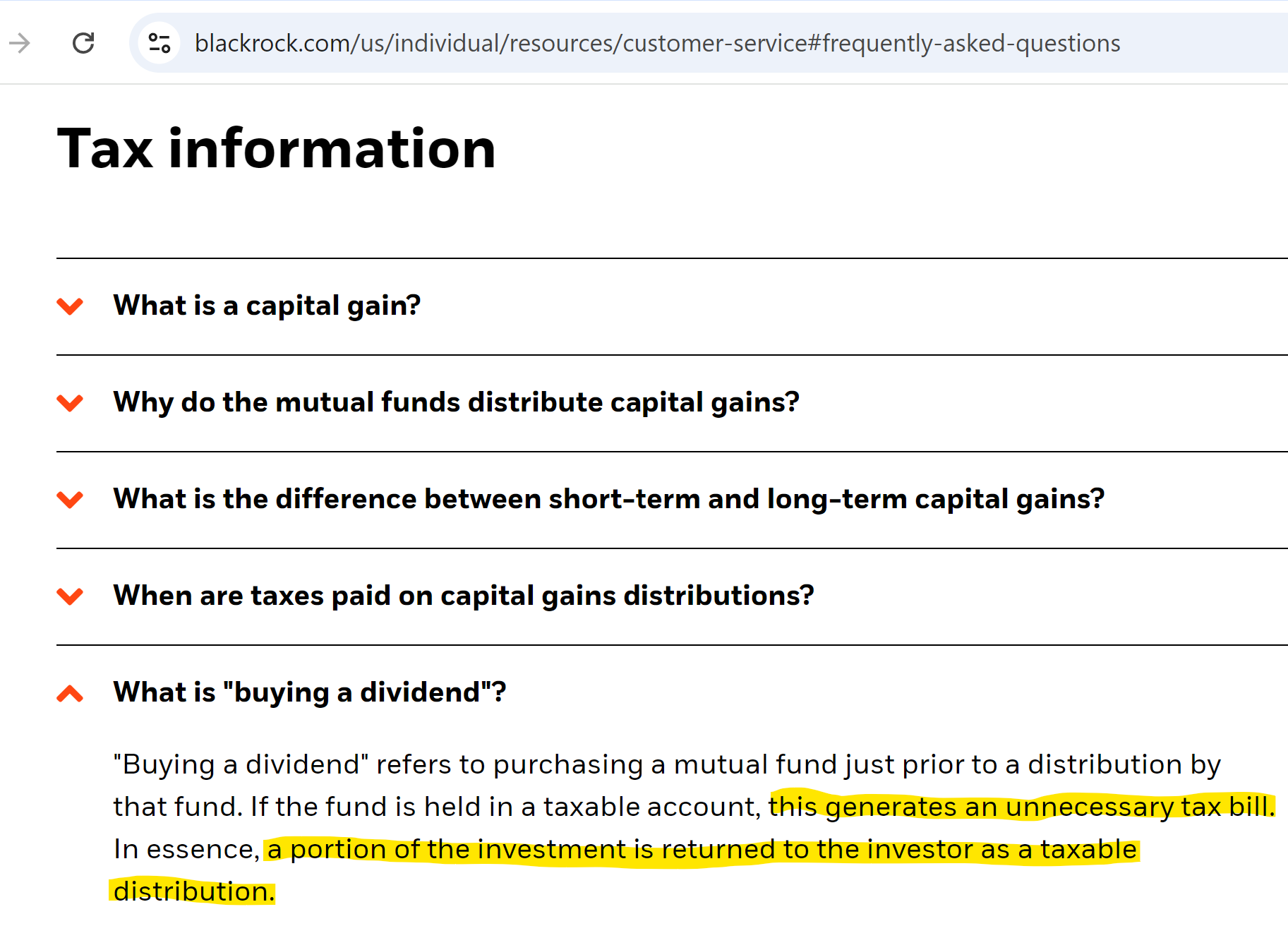
Please don’t be confused by BlackRock’s statement that these losses only happen “just prior to” a distribution. That statement is affirmatively false. The SEC was notified of this misleading statement in 2020. I will write more on the numerous securities law violations in later articles.
Their Defense: Nobody’s Making Them Stop
Two answers from the record explain everything. A senior executive of a fund administration firm, on a Zoom call, on why investment managers would never adopt the fix: “Investment managers are billing on the [inflated] net asset value” (declaration, ¶ 28). On the same call, he confirmed his own firm’s system already contains the setting that would correct the price — and that it stays off because correcting the price shrinks the fee base. That is not one firm defending a policy. That is a gatekeeper describing every manager’s incentive at once, certain none will break ranks.
The second answer is why this case has two defendants. A senior executive of DTCC — the clearing organization that substantially all U.S. fund transactions flow through — on why it would not act either: “If the SEC cared about this, they would be talking about it” (petition, § IX). The government’s ongoing silence was used as an excuse to allow the investor harm to continue. The industry was not hiding from its regulator. It was quoting them.
They can all afford that confidence, and the reasons come in two flavors. Some of the gatekeepers built to check the fund companies bill on the same inflated price the fund companies do — administrators, custodians, broker-dealers, consultants, most charging their percentage of assets — so correction costs them money directly. The rest — the exchanges, the clearing utilities, the self-regulatory organizations — don't bill on the price at all. They have something they value more: the fund companies as customers. And they told me so plainly — that acting on this could anger the clients who pay them, and cost them that business.
I watched that fear operate, more than once, in the same sequence: a gatekeeper reviews the fix, agrees it works, engages on implementing it to protect investors — then talks to its fund-company clients and does a complete 180, suddenly no longer interested, with no explanation and no change in the facts (petition, § VIII). Nothing about the fix had changed. Only one conversation had happened. Fee-takers on one side, client-keepers on the other — and the largest managers are among the gatekeepers' largest shareholders.
Antitrust law has names for arrangements like this; my petition applies them, participant by participant, in Section VIII. This isn't a market failing to correct itself. It's a market organized not to.
The Government Didn’t Miss the Fraud. It Taxed It.
When you want to know why something is happening in government, ask the oldest question in the law: cui bono — who benefits? Ask it here, and the answer arrives fast.
The Supreme Court settled what counts as taxable income ninety years ago: receiving your own capital back is not income, and it cannot be taxed as if it were. The Internal Revenue Code says the same. Yet every April, the Treasury collects tax on exactly that — the returned capital of 160 million Americans, mislabeled as income on hundreds of millions of federal forms — and keeps the money. The Constitution has a word for the government taking money it has no lawful right to take, and my petition puts that word on the record: an unconstitutional exaction — a taking (§ XIV). Not a loophole. Not a gray area. A tax that is not owed, collected anyway on income that does not exist, from people whose rights the Court defined generations ago.
Six Years Through Proper Channels. Then Federal Court.
I spent six years doing this the way you’re supposed to. I was professional and diplomatic.
Somewhere in year six, I stopped asking, and as of this week, I started compelling. The proper channels assume the institutions at the end of them still work; when they don’t, an ordinary citizen has exactly two venues left — the public, and the courts, the last refuge the government cannot quietly close. I have now entered both. This publication is the first. The complaint in Washington is the second — filed myself, pro se. No firm. No funders. A former infantry Marine with receipts, and the legal doctrine Congress and the courts created for exactly this. That is the whole job of a Private Attorney General: both venues, at once. A pincer attack.
The federal case I filed against the SEC is not the last. It is the first. And my disclosures, of which I have many, will increase in intensity with each new case filed or amended complaint submitted. I know a lot of things, and I am willing to put them all on the record.
There Is No Quiet Way Out of This
Understand why this only ends one way. The federal complaint against the SEC puts it plainly: “Either it produces the records, or it explains, under oath, why it will not. Both branches end the silence.”
That logic now runs across every front: every response is a story. Continued silence is additional evidence of institutions that have failed us. There is no quiet way out of any of it — and ‘quiet’ was the only strategy they ever had. Not any more. I control the field now; the law is on my side, and there is no version of this in which the silence survives.
So there is never any confusion about what winning means; here is the entire demand — addressed directly to the government, which reads this page too:
Answer the sixteen questions sitting on your own docket which prove investors have been misled. I have already provided the SEC answers to them. (on the SEC’s docket)
Publish the investor warning I already drafted for you. (on the SEC’s docket)
Produce all “buying a dividend” related records in full.
Collect the IRS penalties for intentional disregard - filing false tax forms that are due before March 31, 2027.
Name the people and firms responsible for what I believe is the largest tax and securities fraud in US history and hold them accountable to the fullest extent allowable under the law. Not the preferred method of “slaps on the wrist” - real accountability.
Every line of that list is somebody’s job description. That is the whole demand — which is why nobody has managed to call it radical.
Two Silences Keep This Running. One of Them Is Yours.
One more thing, because it's the key to everything above: this scheme runs on two silences. The first silence belongs to the government — six years of saying nothing, which the industry treats as a license to continue. The second silence belongs to you. You were never told, so you never objected — and the industry treats your silence as its profit margin. The first silence is now being litigated in federal court. The second ends the moment you decide it does.
In their own words, the arrangement works because you don’t know it is happening. You are not an audience here. You are the jury that was never supposed to be seated.
If you’ve been paying attention to this country, you know this case is not an exception; it has become the norm. You’ve watched the pattern — laws on the books that go unenforced, agencies that answer to the industries they were built to police, consequences that arrive automatically for you and never for them. It spans administrations. It spans parties. And the uncomfortable truth: complaining doesn’t touch it. The pattern has survived fifty years of complaints. Posting about it, agreeing with your friends about it — the machine prices all of that at zero. The only thing it has never survived is citizens who stop complaining and start enforcing the laws that the government has refused to uphold.
The law has a name for that citizen, and it’s the name of this project — the one I told you at the top stands for Private Attorney General. In plain terms: a citizen enforcer. A prosecutor of last resort. Last resort, because that is exactly where this case stands — the industry’s compliance systems failed, the gatekeepers failed, three federal agencies failed, and when every institution built to enforce the law declines to do it, the job doesn’t disappear. It falls to whoever is left: human beings willing to pick it up and prosecute it themselves.
The title was never meant to describe one person. It requires no law degree, no firm, and no one’s permission. It requires only two things — that you are done accepting the status quo, and that you're willing to do something about it.
So here is how you take on the role — and it costs you nothing. Subscribe, free, and every piece of evidence lands in your inbox the moment it enters the record. But understand what your subscription actually does, because it is not a favor to me. Public enforcement runs on witnesses. This very case proves it: with almost nobody watching, a hundred-billion-dollar fraud was routed to the customer-service desk. That is what the government does with a case ten people are watching. A case a hundred thousand people are watching cannot be buried, cannot be routed, cannot be waited out — because every pair of eyes raises the price of silence, and there is a number at which the price gets too high to pay. You are not following this case. You are what makes it dangerous.
If you can afford to fund the work, don’t think of it as a donation — it isn’t one, and I don’t want one. A paid subscription is two things, and only two.
It’s the war chest. It funds this entire fight and keeps me in it — the filing fees, the records fees, the litigation ahead, and the investigation and writing itself, which for six years I have done alone and paid for out of pocket. Subscriptions are what keep the only person prosecuting this case on the field.
It’s also an investment in your own future. You are not a spectator to this harm — it is taking roughly $600 or more a year from the average fund investor, every year, compounding against your retirement the whole time. The subscription costs a fraction of one year’s loss, and it funds the only active legal effort to stop the taking. If this works, the return doesn’t show up here. It shows up in your bank account, every year, for the rest of your life. You’re not buying articles. You’re arming your own case.
And if money is tight right now — keep it. I mean that. You are the person this case exists to protect, and I am not going to fight the people taking your money by asking for your money. Everything published here is free.
If you want to give something that matters just as much, give this: share these articles and videos on your social media channels and send them to your friends, family, and to the media. Awareness is what ends this.
And know what you will be joining. This case — what I consider to be the largest financial fraud in American history, and the government that profits from it — is the first matter before the Private Attorney General Project. It is not the last. This is only the beginning.
The country has enough bystanders. Bystanders are how this scheme survives. Citizen enforcers — the prosecutors of last resort — are how it dies.
Become one.
See you on The Docket. — JeremyDisclaimer — publisher information updated September 16, 2026. This article was first published August 20, 2026, before the August 21 contribution of the publication assets by PAG PROJECT LLC (Texas) to the current operator, PAG PROJECT, a Florida limited liability company (Florida document L26000442232). Jeremy Roseberry remains the author. This administrative update preserves the article’s original publication date.
This post presents the author’s reporting, allegations, analysis and opinions on matters of public concern. Readers should evaluate the cited records and context. Allegations in a petition or complaint are not adjudicated findings; filing with an agency or court does not establish government endorsement. Characterizations such as “fraud,” and a person’s whistleblower or petitioner status, do not by themselves create immunity for false factual assertions. Nothing in this disclaimer asserts that any person or entity has been charged with or convicted of a crime. The author is not a lawyer. This publication does not provide individualized legal, tax or investment advice.
Our Publisher Terms, including Section 11, and Legal & Disclaimers explain editorial corrections and statutory notice and retraction protections where applicable. They do not impose a universal pre-suit requirement or bind every reader or story subject merely through access. Corrections and retraction requests: Review@pagproject.com.